
Hair Fall: Causes, Treatment and What You Can Do About It
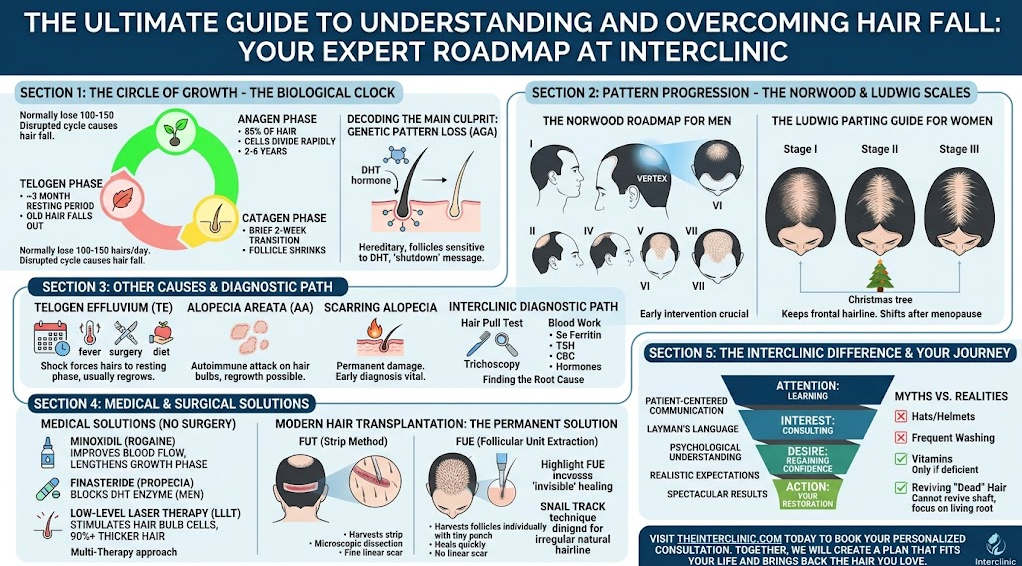
Hair Fall: Why Is Your Hair Falling Out?
Have you noticed more hair than usual on your pillow?
Perhaps you see extra strands in your comb, shower drain or on your shirt.
At first, it may not seem like a big deal. However, when the hair fall continues, you may start noticing a thinner hairline, a wider parting or more scalp showing through your hair.
That is when many people start to worry.
Hair fall is common. Yet, it can mean different things for different people.
Sometimes, hair fall happens because of stress or illness. In other cases, it can be caused by genetics, hormones, nutrition or certain medical conditions.
More importantly, some types of hair fall are temporary. Others can slowly become permanent.
Therefore, knowing why your hair is falling out is the first step toward choosing the right treatment.
At Interclinic Medicine & Surgery Clinic, we believe that hair fall should be approached with proper assessment rather than guesswork.
Instead of simply asking how much hair you have lost, we look at the bigger picture.
We consider your hair-loss pattern, scalp condition, medical history, lifestyle, family history and long-term goals.
Consequently, we can help you understand what may be causing your hair fall and what options may be suitable for you.
Whether you are noticing your first few signs of thinning or have already developed visible bald areas, it is never too early to understand what is happening.
What Is Hair Fall?
Hair fall refers to the loss or shedding of hair from the scalp.
Some hair fall is completely normal.
Your scalp has thousands of hair follicles. Each follicle goes through its own growth cycle. As old hairs finish their cycle, they fall out and can eventually be replaced by new hairs.
Therefore, seeing a few hairs on your pillow or in the shower does not automatically mean that you have a hair-loss problem.
The concern starts when you notice a clear change.
For example, you may see:
- More hair falling than usual
- A receding hairline
- Thinning around the crown
- A wider centre part
- A thinner ponytail
- More scalp becoming visible
- A bald patch
- Hair becoming finer over time
- Sudden heavy shedding
- Hair loss from the eyebrows or other areas
Because hair fall can develop slowly, it is easy to overlook the early signs.
In fact, you may not notice the change until someone else points it out.
A simple way to monitor your hair is to take photographs from the front, top and sides every few months.
This can help you see changes that are difficult to notice from day to day.
The Hair Growth Cycle: Why Does Hair Fall Happen?
To understand hair fall, we first need to understand the hair-growth cycle.
Every hair grows from a structure called a hair follicle.
Think of the follicle as a small production unit underneath your skin.
It produces the hair shaft and controls how long that hair continues to grow.
Your hair normally moves through three main stages.
1. Anagen — The Growth Stage
The anagen phase is the active growth stage.
During this period, cells inside the follicle work continuously to produce the hair shaft.
This stage can last for several years.
The longer your hair stays in the growth phase, the longer it can potentially become.
2. Catagen — The Transition Stage
After the growth stage, the follicle enters the catagen phase.
This is a short transition period.
The follicle becomes smaller and prepares to rest.
3. Telogen — The Resting Stage
Finally, the follicle enters the telogen phase.
The hair stops actively growing.
After the resting period, the old hair eventually falls out.
Then, under normal conditions, the follicle can begin another growth cycle.
So, some hair fall is part of normal biology.
The problem occurs when this balance becomes disrupted.
For example, too many hairs may enter the resting phase at the same time.
Alternatively, some follicles may gradually become smaller.
That is why different types of hair fall can look very different from one another.
The Most Common Cause of Hair Fall: Genetics
One of the most common causes of progressive hair thinning is Androgenetic Alopecia (AGA).
You may also hear it called pattern hair loss or common baldness.
This condition is strongly influenced by genetics.
In genetically sensitive follicles, a hormone called Dihydrotestosterone (DHT) plays an important role.
Over time, sensitive follicles can become smaller.
As the follicle becomes smaller, the hair it produces can also become finer and shorter.
This process is called miniaturisation.
Eventually, the hair may become so fine that it is barely visible.
That is why someone can appear to have “lost” a large amount of hair even though many follicles may still be present.
The key issue is that those follicles are producing much smaller hairs.
Hair Fall in Men: Male Pattern Hair Loss
Men often notice hair fall around the temples or front hairline first.
The hairline may slowly move backwards.
At the same time, the crown may begin to look thinner.
As the condition progresses, the thinning areas can become larger.
Doctors often use the Norwood-Hamilton Scale to describe the different stages of male pattern hair loss.
However, you do not need to wait until your hair loss reaches an advanced stage before seeking advice.
In fact, early assessment can be useful.
Why?
Because follicles that are still producing hair may have more potential to respond to appropriate treatment than follicles that have been severely miniaturised for a long time.
Therefore, if you notice a receding hairline or thinning crown, consider getting it assessed early.
Hair Fall in Women: Female Pattern Hair Loss
Women can also experience genetic hair thinning.
This is commonly known as Female Pattern Hair Loss (FPHL).
However, the pattern often looks different from male hair loss.
Instead of a strongly receding hairline, women often notice thinning across the top of the scalp.
The centre part may gradually become wider.
Furthermore, the overall volume of the hair may decrease.
Many women still maintain their frontal hairline.
The Ludwig Scale can be used to describe the progression of female pattern hair loss.
However, female hair fall deserves careful assessment because several other factors can cause or worsen thinning.
Hormonal changes, nutritional problems, thyroid issues and other medical conditions may need to be considered.
Consequently, women should not automatically assume that thinning hair is simply genetic.
A proper assessment can help identify the most likely cause.
Hair Fall After Stress, Illness or Weight Loss
Not every case of hair fall develops slowly.
Sometimes, hair suddenly starts shedding several weeks or months after a major event.
One common example is Telogen Effluvium (TE).
This type of hair shedding can occur after physical or emotional stress.
For instance, triggers may include:
- High fever
- Significant illness
- Major surgery
- Severe stress
- Sudden weight loss
- Crash dieting
- Major changes in the body
Interestingly, the hair fall may not happen immediately.
Instead, you may notice increased shedding two or three months after the event.
This delay can make the cause difficult to identify.
For example, you may think, “Why is my hair suddenly falling now?”
The answer may be something that happened months earlier.
The good news is that telogen effluvium can often improve when the underlying trigger is addressed.
Therefore, patience can be important.
At the same time, persistent or severe hair fall should still be assessed because more than one type of hair loss can occur together.
Alopecia Areata: When Hair Fall Appears in Patches
Have you suddenly noticed a smooth, round bald patch?
If so, it may be Alopecia Areata.
Alopecia areata is an autoimmune condition.
In simple terms, the body’s immune system mistakenly attacks the hair follicles.
As a result, hair can suddenly fall out in clearly defined patches.
The affected skin often looks smooth and normal.
Unlike scarring alopecia, the follicle is not necessarily destroyed.
Therefore, regrowth can occur in many cases.
However, alopecia areata can behave unpredictably.
Some people develop one small patch.
Others may experience more extensive scalp hair loss.
In more severe cases, the condition can progress to Alopecia Totalis, which involves loss of scalp hair, or Alopecia Universalis, which can involve hair loss across the body.
Because of this, sudden patchy hair fall should be properly assessed rather than treated as ordinary genetic hair thinning.
Scarring Alopecia: Why Early Assessment Matters
Another type of hair loss is Cicatricial Alopecia, also known as scarring alopecia.
This condition is different from ordinary hair shedding.
Here, inflammation can damage the hair follicle itself.
If the follicle becomes permanently destroyed and replaced by scar tissue, the hair may no longer grow from that area.
That is why early assessment matters.
Pay particular attention if hair fall occurs together with symptoms such as:
- Scalp pain
- Burning
- Significant itching
- Redness
- Scaling
- Inflammation
- Smooth areas that look scarred
These signs should not simply be ignored.
The earlier the underlying condition is identified, the sooner appropriate treatment can be considered.
What Else Can Cause Hair Fall?
Genetics is important.
However, it is not the only factor.
Hair fall can also be influenced by your general health, nutrition, medications and lifestyle.
For example, a very restrictive diet may leave your body without enough nutrients to support normal hair growth.
Similarly, some medications and medical conditions can affect the hair cycle.
Hormonal changes may also influence hair growth.
In addition, repeated pulling from tight hairstyles can cause traction alopecia.
Frequent chemical treatments, excessive heat and rough handling can also damage the hair shaft.
That does not necessarily mean the follicle itself is damaged.
Instead, the hair may break before it reaches its normal length.
Therefore, it is important to distinguish between hair falling from the follicle and hair breaking along the shaft.
They may look similar.
However, they require different approaches.
How Do We Find the Cause of Hair Fall?
At Interclinic Medicine & Surgery Clinic, the first step is understanding your individual situation.
We do not believe that every person with hair fall needs the same treatment.
First, we look at your medical history.
We may ask when the hair fall started.
We may also ask whether it happened suddenly or gradually.
Next, we consider your family history.
A strong family history of male or female pattern hair loss can provide useful clues.
Your diet, medications, lifestyle and recent illnesses may also matter.
After that, we examine your scalp and hair.
Hair Pull Test
A Hair Pull Test can provide information about active shedding.
It helps the doctor understand whether more hairs than expected are currently entering the shedding phase.
Trichoscopy
Another useful tool is trichoscopy.
This allows the scalp and individual hairs to be examined at higher magnification.
It can help identify signs such as hair miniaturisation and other scalp or follicle changes.
Blood Tests
In some patients, blood tests may also be appropriate.
Depending on the individual’s history and clinical findings, investigations may include tests related to:
- Iron status
- Thyroid function
- General blood health
- Hormonal factors
- Other possible medical causes
The exact tests should depend on your symptoms and medical assessment.
The goal is simple:
Find the cause before choosing the treatment.
Hair Fall Treatment Without Surgery
The good news is that not every person with hair fall needs a hair transplant.
Medical treatment may be appropriate for many patients.
The treatment depends on the underlying cause.
Minoxidil
Minoxidil is one of the established medical treatments used for certain types of hair loss.
It can help support hair growth and may reduce hair shedding in appropriate patients.
However, results take time.
Therefore, patients should not expect dramatic changes after a few weeks.
Consistent treatment and realistic expectations are important.
Finasteride
For suitable men with male pattern hair loss, doctors may prescribe Finasteride.
This medication reduces the body’s conversion of testosterone into DHT.
As a result, it can help address one of the hormonal factors involved in male pattern hair loss.
However, finasteride is a prescription medicine.
It is not suitable for everyone.
Therefore, discuss its benefits, risks and possible side effects with a doctor before starting treatment.
Low-Level Laser Therapy
Low-Level Laser Therapy (LLLT) is another option that may be considered for selected patients.
It uses low-level light to stimulate activity around the hair follicle.
However, it should not be viewed as a miracle cure.
Instead, it may form part of a broader hair-restoration plan.
Nutrition and Hair Fall
Your hair needs the right building blocks to grow.
Therefore, nutrition can matter.
If you have a genuine nutritional deficiency, correcting it may support healthier hair growth.
However, taking large amounts of vitamins does not automatically stop hair fall.
In fact, more is not always better.
Some supplements may only be useful when a deficiency exists.
That is why it is better to identify the problem before taking multiple supplements.
A balanced diet, adequate protein and appropriate nutrition can support overall health.
Nevertheless, supplements should not replace a proper medical assessment when hair fall is persistent.
When Is a Hair Transplant Appropriate?
Medical treatment can help protect and improve existing hair.
However, medicine cannot always replace hair that has already been permanently lost.
That is where hair transplantation may have a role.
A hair transplant does not create brand-new follicles.
Instead, suitable hair follicles are moved from a donor area to an area affected by thinning or baldness.
The donor area is usually located at the back or sides of the scalp.
The transplanted follicles can then grow hair in their new location.
However, not everyone is a suitable candidate.
Your donor density matters.
Your hair-loss pattern matters too.
So do your age, scalp condition and expectations.
Most importantly, your future hair-loss pattern should also be considered.
A good hair transplant plan should not only ask:
“How do we fill the bald area today?”
It should also ask:
“What will your hair look like several years from now?”
FUE vs FUT: Which Hair Transplant Method Is Better?
Two well-known hair transplant techniques are FUE and FUT.
Neither technique is automatically the best choice for everyone.
The right method depends on the individual patient.
FUE — Follicular Unit Extraction
With FUE, individual follicular units are harvested from the donor area.
A small punch is used to extract the grafts.
The grafts are then prepared and placed into the thinning or bald areas.
Because FUE does not require removing a strip of scalp, it does not leave the same linear scar associated with FUT.
Therefore, FUE can be attractive to patients who prefer shorter hairstyles.
FUT — Follicular Unit Transplantation
With FUT, the surgeon removes a thin strip of scalp from the donor area.
The strip is then carefully divided into individual follicular units.
These grafts are subsequently prepared for transplantation.
FUT can allow efficient harvesting in selected cases.
However, it leaves a linear scar in the donor area.
So, the decision between FUE and FUT should not be based simply on which technique sounds newer.
Instead, the doctor should consider your donor area, hair characteristics, expected graft requirements, hairstyle and long-term plan.
Creating a Natural-Looking Hairline
A successful hair transplant is not simply about moving as many hairs as possible.
Naturalness matters.
The hairline must suit your face.
It must also suit your age and future hair-loss pattern.
Natural hairlines are not perfectly straight.
They have subtle irregularities.
This is why careful hairline design is so important.
At the front of the hairline, finer grafts can help create a softer transition.
Behind that area, greater density can be built progressively.
The direction and angle of each graft also matter.
When these details are planned carefully, the transplanted hair can blend more naturally with your existing hair.
Therefore, hair restoration is both a medical procedure and an exercise in aesthetic judgement.
The goal is not simply to create more hair.
The goal is to create hair that looks like it naturally belongs to you.
Hair Fall Myths You Should Stop Believing
When people experience hair fall, they often search online for quick solutions.
Unfortunately, this can lead to expensive products and unrealistic promises.
Here are a few common myths.
Myth 1: Hats Cause Hair Fall
Wearing a normal hat or helmet does not automatically cause hair fall.
However, anything that creates constant pulling or traction may contribute to certain types of hair loss.
Myth 2: Washing Your Hair Causes Hair Fall
Seeing hair in your shower does not necessarily mean that shampoo caused it.
Those hairs may already have been ready to shed.
Good scalp hygiene remains important.
Myth 3: Vitamins Can Stop All Hair Fall
Vitamins can help when you have a genuine deficiency.
However, taking more vitamins does not automatically mean you will grow more hair.
Myth 4: Dead Hair Can Be Brought Back to Life
The visible hair shaft is made largely of keratin and is not living tissue.
Therefore, treatments aimed at improving hair growth need to focus on the scalp and follicle rather than simply coating the existing hair.
This is why understanding the root cause matters more than buying another “miracle” hair product.
Why Choose Interclinic for Hair Fall Assessment?
Choosing where to seek help for hair fall is an important decision.
At Interclinic Medicine & Surgery Clinic, we believe patients deserve clear information.
Medical terms can sometimes sound complicated.
Therefore, we explain the condition in simple language.
We also believe that realistic expectations are part of good treatment.
A hair transplant cannot give everyone the same density.
Likewise, medication cannot guarantee the same response in every patient.
Your hair is unique.
Your donor area is unique.
Your pattern of hair fall is unique.
Consequently, your treatment plan should be personal too.
We use a patient-centred approach to guide you from understanding your problem to choosing an appropriate treatment option.
The process is not about rushing you into surgery.
Instead, it is about helping you understand your choices.
Frequently Asked Questions About Hair Fall
How long does hair fall treatment take to work?
Hair treatment usually takes time.
Depending on the cause and treatment, some patients may notice reduced shedding within several months.
Visible improvement in hair density can take longer.
Therefore, patience and consistency are important.
Is a hair transplant painful?
Hair transplantation is commonly performed using local anaesthesia.
During the procedure, you should not expect significant surgical pain.
However, some pressure or discomfort may occur.
Your doctor will explain what to expect before the procedure.
Will transplanted hair fall out?
Some transplanted hairs may temporarily shed after transplantation.
This can be part of the normal post-transplant process.
The transplanted follicles can then produce new hair as they enter their next growth cycle.
Long-term results depend on factors such as donor hair quality, technique, healing and individual biology.
Do I need a hair transplant if my hair is thinning?
Not necessarily.
Some people may benefit from medical treatment first.
Others may have areas of permanent hair loss where transplantation could be considered.
That is why proper assessment should come before deciding on surgery.
When Should You See a Doctor About Hair Fall?
You should consider an assessment if your hair fall is persistent or clearly changing your appearance.
In particular, seek professional advice if you notice:
- A receding hairline
- Thinning at the crown
- A widening hair part
- Sudden heavy shedding
- Round bald patches
- Rapid changes in hair density
- Scalp pain or burning
- Persistent scalp itching
- Redness or scaling
- Hair loss from the eyebrows or eyelashes
- Hair fall after a major illness
- Hair fall after significant weight loss
- A strong family history of baldness
Most importantly, do not wait until you feel completely bald before seeking help.
Early assessment may give you more options.
Your Hair Fall Journey Starts With Understanding
Hair fall is not simply about losing a few strands.
For some people, it affects confidence.
For others, it changes the way they feel when looking in the mirror.
Some may avoid photographs.
Others may spend more time styling their hair to hide thinning areas.
However, you do not have to make decisions based on fear.
Modern hair restoration offers several options.
Depending on the cause, these may include lifestyle changes, nutritional correction, medical treatment, laser-based approaches or hair transplantation.
The important part is choosing the right approach for the right problem.
At Interclinic Medicine & Surgery Clinic, we believe that starts with understanding your hair fall.
We take the time to look at your individual pattern.
We consider the possible causes.
Then, we discuss what may realistically help.
Whether you have only just noticed your hairline changing or you have been dealing with hair fall for years, the first step remains the same.
Find out why your hair is falling.
Once you understand the cause, you can make a better decision about what to do next.
Ready to Understand Your Hair Fall?
You do not need to guess why your hair is falling.
You do not need to try every shampoo, supplement or internet remedy.
And you do not automatically need a hair transplant.
Start with a proper assessment.
At Interclinic Medicine & Surgery Clinic, we can help you understand your hair and scalp, identify possible causes of hair fall and discuss treatment options that fit your situation.
Your hair fall has a reason.
Find the reason. Understand your options. Plan your next step.
Visit: theinterclinic.com
Interclinic Medicine & Surgery Clinic
Professional assessment. Clear advice. Personalised hair restoration planning.